
Anxiety Test
Inquiry Health LLC
Installs
100K+
Developer
Inquiry Health LLC
-
Category
Health & Fitness
-
Content Rating
Everyone
Developer Email
Privacy Policy
https://inquiryhealth.com/testprivacypolicy/index.html
Screenshots
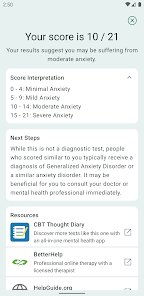
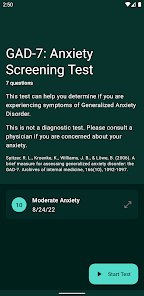
Expert Review
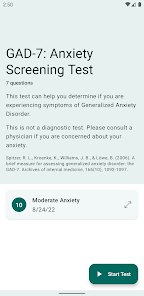
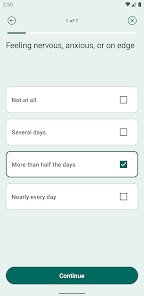
Anxiety Test, published by Inquiry Health LLC, is a self-screening tool built around a structured questionnaire that mirrors established clinical instruments for measuring anxiety severity. The app presents a series of statements about mood, worry, physical tension, and sleep, and asks users to rate how closely each one reflects their recent experience. Once the items are answered, the app tallies the responses into a summary score and maps that score onto a severity band, giving users a rough sense of where their symptoms fall on a mild-to-severe continuum. The underlying premise is simple: many people feel anxious but lack a clear way to gauge how much their symptoms interfere with daily life, and a quick, private check-in can serve as a first step toward deciding whether to seek help.
The primary audience is adults who suspect their worry or restlessness has crossed from ordinary stress into something more persistent, along with people already in therapy who want a lightweight way to track how they are doing between sessions. The app addresses a real gap, since formal assessments usually require a clinician's time, and general mood-tracking apps tend to focus on broad emotional logging rather than anxiety-specific symptom patterns. Within its narrow scope, the questionnaire is easy to complete, the scoring logic is transparent, and the results screen explains what a given score band generally implies. That said, the app is a screening aid rather than a diagnostic instrument, and it does not attempt to replicate the follow-up questions a trained professional would ask.
In everyday use, the app fits naturally into brief moments: a few quiet minutes in the morning, a pause after a stressful meeting, or a weekly check-in before a therapy appointment. Seeing scores shift over time can help users notice that their anxiety rises in particular situations, such as before deadlines or during certain social encounters, which is often more useful than a single number. The value hinges on honest answers; rushing through the items produces a score with little meaning. It also works best as a conversation starter, giving users concrete language and numbers to bring to a doctor, counselor, or trusted friend instead of vague descriptions.
Anxiety Test is a sensible recommendation for people who want a private, low-friction starting point for understanding their anxiety, and for therapy clients who like having a simple metric to discuss. It is less suited to anyone seeking a diagnosis, a treatment plan, or crisis support, and it should not replace professional care. Users who approach it as a screening and tracking aid, combined with real-world support, will get the most from it.
Key Functional Highlights
- ✨ A structured self-assessment questionnaire rates anxiety-related symptoms such as excessive worry, restlessness, and physical tension, then converts the responses into a severity score so users can see roughly where their symptoms sit.
- ✨ A results breakdown explains what the total score means and places it into a severity category, helping users interpret the number rather than leaving them with a bare figure.
- ✨ Saved assessment history lets users compare scores across multiple check-ins, making it easier to spot trends, such as a gradual rise in anxiety before a stressful period.
- ✨ Educational content about anxiety and guidance on when to consider professional help give context to the results and point users toward appropriate next steps.
Advantages & Benefits
- ✅ The questionnaire is short and straightforward, so a check-in takes only a few minutes and rarely feels like a chore.
- ✅ Scores are presented in plain language with brief interpretation, which makes the results accessible to users without a clinical background.
- ✅ The screening runs privately on the device, which lowers the barrier for people who feel uneasy discussing anxiety face to face.
- ✅ Storing past results supports self-monitoring over weeks, turning a one-off test into a modest tracking habit.
Areas for Improvement
- ⚠️ The app screens for anxiety but cannot diagnose it, and its severity bands are approximations that may not reflect how symptoms actually affect someone's life.
- ⚠️ Results depend entirely on self-report, so hurried or guarded answers can skew scores in either direction.
- ⚠️ The tool offers limited guidance beyond general advice, and users with moderate to severe scores may find themselves unsure what concrete action to take next.
- ⚠️ It is not designed for crisis situations, so anyone experiencing acute distress needs direct human support rather than an app-based check.
Recommended Apps
![]()
Fingerprint Scan
T-Bridge Technologies2
![]()
FWC2026 Mobile Tickets
FIFA2.1![]()
SafeAllergy - Allergen Scanner
MedCoderX0![]()
Uber - Request a ride
Uber Technologies, Inc.4.5
![]()
Gay Dating & LGBT Hookup App
Hookup Apps to Hook up Local Dating4.5![]()
ZEDGE™ Wallpapers & Ringtones
Zedge4.5![]()
ESPN
Disney4.3![]()
How Old Do I Look - Age Camera
Lucky Studio Games & App4![]()
Recovery Pro - File Recovery
Makes Your Life Easier4.3![]()
Doodle Master - Glow Art
Hydodo4.5![]()
Dog Prank Call & Chat
GOBEEZ YAZILIM TİCARET3.4![]()
My Cartoon Character
Andromeda App3.7![]()
PrankGen - Funny Prank Sounds
DATONG FUN3.8![]()
16Personalities
16Personalities4![]()
Pollo AI: AI Video Generator
COCOSOFT TECHNOLOGY PTE. LTD.4.4










You May Like
-
![]()
My Character: Cartoon Filter
CEM SOFTWARE LTD4.5 -
![]()
DIY Emoji - Sticker Maker
Braly JSC0 -
![]()
Face Live Camera: Face Filters
Lyrebird Studio4.1 -
![]()
TeraBox: 1TB Cloud & AI Space
Flextech Inc.4.4 -
![]()
Pretty Makeup - Beauty Camera
Photo Editor Perfect Corp.4.4 -
![]()
Secret Crush Detector App
Hopeitz Software4.8 -
![]()
LINE Sticker Maker
LINE (LY Corporation)4.7 -
![]()
ANIME Live Wallpapers
Live Wallpapers Expert4.3 -
![]()
MagicWidgets: Themepack & Icon
One Office Premium3.3 -
![]()
Version AI: AI Photo Generator
Apptribe Dijital4.5 -
![]()
Future Self Face Aging Changer
AMOBEAR TECHNOLOGY GROUP4 -
![]()
Bug Filter: Funny Prank App
HKL Game Studio0 -
![]()
FalFal: Astrology, Tarot, Love
FalFal Team4.8 -
![]()
Water Reminder - Remind Drink
recorder & smart apps4.8 -
![]()
Sprout - AI Job Search
Magnifex4.4