

Disco Fighter: Dead Fight Club
Wawe Technology
Installs
Developer
Wawe Technology
-
Category
Aciton
-
Content Rating
Teen
Developer Email
Privacy Policy
https://docs.google.com/document/d/1hrM5-UNNnaOfePLsfPx0c9ahIiWfwLseQnEqrj4fenU/edit?tab=t.0
Screenshots
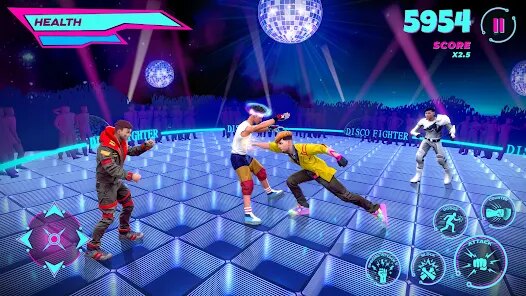
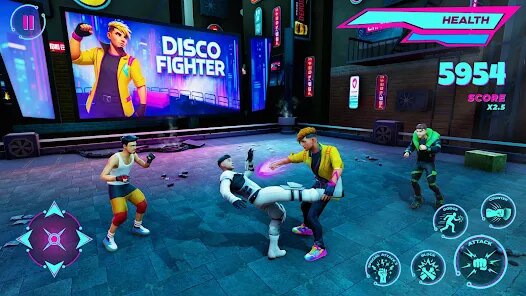
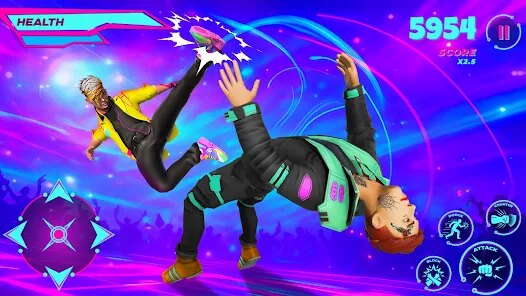
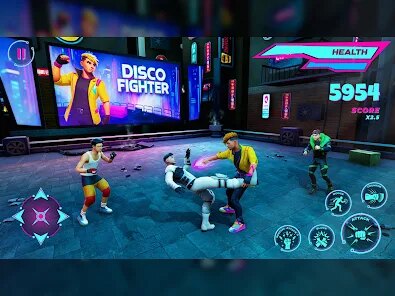

In-Depth Game Analysis
Disco Fighter: Dead Fight Club by Wawe Technology is a curious blend that doesn't fit neatly into any single box. At its core, it's a rhythm-based action brawler where you punch, kick, and dodge to the beat of a synthesized, retro-futuristic soundtrack. The core loop is deceptively simple: enemies approach in waves, and your attacks are only effective when timed perfectly with the music's downbeats. Think of it as a love child between a classic arcade fighter and a rhythm game like Crypt of the NecroDancer, but with a sleazy, neon-soaked aesthetic that screams 1980s VHS tape. This isn't a game for pure strategy buffs or those seeking deep narrative; it's for players who enjoy a kinetic challenge, who love that "flow state" when gameplay and music sync up perfectly. Casual gamers might find the initial difficulty spike intimidating, but anyone with a pulse for synthwave and a willingness to learn patterns will find a lot to love. What initially hooked me wasn't the hype or social buzz — it was the trailer's visual style: grainy, glitchy, and unapologetically loud, with character designs that looked like they'd escaped a forgotten arcade cabinet. I had to see if the experience matched the vibe.
My first few sessions were rough, to be honest. The game demands a near-perfect sense of timing, and my early attempts were less "disco fighter" and more "flailing on the dance floor." It took a good hour before the controls started feeling like an extension of my thoughts rather than a barrier to them. The learning curve is steep, but it's also fair — you're not fighting the camera or clunky UI; you're fighting your own rhythm. Once I stopped trying to button-mash and started truly listening to the bassline, something clicked. A standout moment came during a boss fight against a chrome-plated cyborg with a mohawk. The track shifted into a slower, heavier tempo, and I realized the boss's attack patterns were literally synchronized to the snare hits. Successfully parrying a flurry of punches exactly on the off-beat, then landing a devastating counter that sent him crashing through a mirror — that was pure adrenaline. The level design, mostly dark corridors and gladiatorial arenas, never distracts, and the UI is refreshingly minimal, letting you focus on the enemy's telegraphs and the pulsing audio. I found that turning the vibration off on my controller actually improved my accuracy, and switching to headphones was non-negotiable; the surround sound gives you a split-second edge that speakers just can't replicate.
As someone who cycles through a dozen fighting and action games a year, I kept coming back to Disco Fighter because it respects your time and your intelligence. It doesn't pad out content with meaningless fetch quests or tacked-on upgrade trees that force grinding. The progression is purely skill-based, which is becoming a rarity. It also sidesteps the pay-to-win landmines that plague so many modern releases — everything you unlock is purely cosmetic, from new glow-stick batons to jacket colors. That, combined with a genuinely reactive enemy AI that adapts to your common combo patterns (they start blocking if you spam the same move), makes it feel like a real duel rather than a scripted encounter. I believe it stands out because it commits fully to its gimmick; the music isn't just background noise, it's the game's skeleton. Similar titles often treat rhythm as a secondary layer, but here it's the foundation. The downside? It's a niche appeal. If you're tone-deaf or hate being forced to move to a beat, this will frustrate you endlessly. But for those who get it, it's a masterclass in audio-gamplay integration, offering satisfying loops and a rewarding challenge that few others can match.
Core Gameplay Features
- Rhythm-based combat system 🥁 Your attacks and dodges are only effective when timed to the beat. The game provides visual cues like a pulsing ring around your character, but the real feedback is audio. It turns every fight into a dance, where mastering the tempo is more important than mashing buttons.
- Beat-synced enemy patterns 🎧 Each enemy type has a tell tied to the music. A shielded brute might lunge on the off-beat, while a fast attacker strikes on every other snare hit. This forces you to memorize audio patterns, creating a unique puzzle layer that changes with each track.
- Style meter and combo system 💥 Land consecutive hits on rhythm to build a multiplier that increases your damage output and unlocks flashy finishers. Miss a beat, and your meter resets to zero. It's a harsh penalty for sloppiness but a satisfying reward for precise play, encouraging you to stay in the zone.
Strengths & Highlights
- Incredible sense of flow 🌊 When you get into the groove, the game feels like a perfect dance. Time slows down, your inputs become automatic, and you're weaving through attacks while laying down punishment. It's a meditative state that few action games can replicate, making each session feel therapeutic despite the violence.
- Fair but challenging difficulty ⚖️ The game never cheats. Deaths always feel like your own fault, stemming from a mistimed dodge or a misplaced combo. There are no cheap hits or unfair enemy spawns. This fairness keeps you motivated to improve rather than throwing the controller in frustration.
- Pure cosmetic progression 👕 All unlockables are purely aesthetic, from new fighting poses to neon trails behind your fists. This ensures a level playing field for all players, removing any grind or pressure to "keep up" with meta builds. It's a refreshing design choice that prioritizes player skill over in-game wealth.
Limitations to Consider
- Steep initial learning curve 📉 The game throws you into deep water without a proper tutorial on how to read the beat visually. Some players might struggle for several hours feeling like they're missing something fundamental. A "practice mode" with slower tracks would have helped ease newcomers into the unique mechanics.
- Limited track variety 🎵 While the synthwave soundtrack is excellent, there are only around 15 unique tracks, and they get repeated across different levels with minor remixes. After several playthroughs, the audio becomes predictable, decreasing the replayability factor. More diverse musical genres or user-created content would breathe new life into the experience.
- Lack of online multiplayer 🌐 The game is strictly a single-player experience or local couch co-op. Given the competitive nature of its combat, an online versus mode where you could battle other players' rhythm patterns would have added massive replay value. As it stands, the post-story content is limited to grinding for higher scores on the same levels.
Recommended Apps
![]()
Halloween: Secret of Shadow
HFG Entertainments4.5

![]()
Disco Fighter: Dead Fight Club
Wawe Technology0![]()
Swamp Attack
Outfit7 Limited4.6![]()
Monster Craftsman Survivor 3D
DINO GAME4.7![]()
Smashero.io - Hack n slash RPG
KLASH Games Inc.4.7![]()
Slice Master : Idle Clicker
Oreon Studios4.6![]()
MECCHA CHAMELEON
PlayLand Studio0![]()
Garten of Banban 2
Euphoric Brothers Games4![]()
Bike Race: Racing Game
iKame Games - Zego Studio4.6![]()
Hapunan Horror Game
2002 Studio4.3![]()
MiniGiants.io
Night Steed S.C.4.4![]()
Peppa Pig by PlayShifu
PlayShifu3.2![]()
Squishy Magic: ASMR Toy Maker
Dramaton4.6![]()
Gangster Simulator Crime Game
Orbit Games Pvt Ltd3.3![]()
Squid Game: Unleashed
Netflix, Inc.4.4











You May Like
-
![]()
IQ Test
Aliaksandr Uvarau4 -
![]()
MONOPOLY GO!
Scopely4.6 -
![]()
Race Master 3D: Car Racing
Beresnev Games4.5 -
![]()
Steal a Brainbot
finik0 -
![]()
World of Peppa Pig: Kids Games
Find Your Fun3.4 -
![]()
Minefun İo
3Dmobiles0 -
![]()
Stealth Master: Assassin Ninja
SayGames Ltd4.3 -
![]()
Witch Match Puzzle: Halloween
JULYis4.6 -
![]()
My Talking Angela 2
Outfit7 Limited4.4 -
![]()
Haunt the House: Terrortown
SFB Games4.9 -
![]()
Solo Survivor IO Game
FALCON GAME4.7 -
![]()
Arknights
Yostar Limited.4.5 -
![]()
Chapters: Interactive Stories
Crazy Maple Studio Dev4.4 -
![]()
ZooTone: Animal Voice Fun
JUP Game Studio4.5 -
![]()
eFootball™
KONAMI4.2